There Are Two Different Reasons to Change Jewelry
People use the phrase “change the jewelry” for two very different situations.
The first is a healing-related fit change.
The second is a decorative change because you want a different look.
Those should not automatically happen at the same time.
A professional downsize may be appropriate before the piercing is fully healed. A casual style change usually needs to wait until the channel is sufficiently stable.
That distinction prevents a lot of confusion.
The Complete Guide to Getting a Piercing at Against the GrainWhy Initial Jewelry Is Often Longer
Fresh piercings swell.
If the initial jewelry fits tightly against the tissue before swelling begins, there may be nowhere for that swelling to go.
That can create pressure and increase the risk of embedding.
For that reason, many initial posts and bars include extra room.
The jewelry may look longer than you expected on day one because it is sized for the early healing phase, not necessarily the final healed appearance.
What Downsizing Means
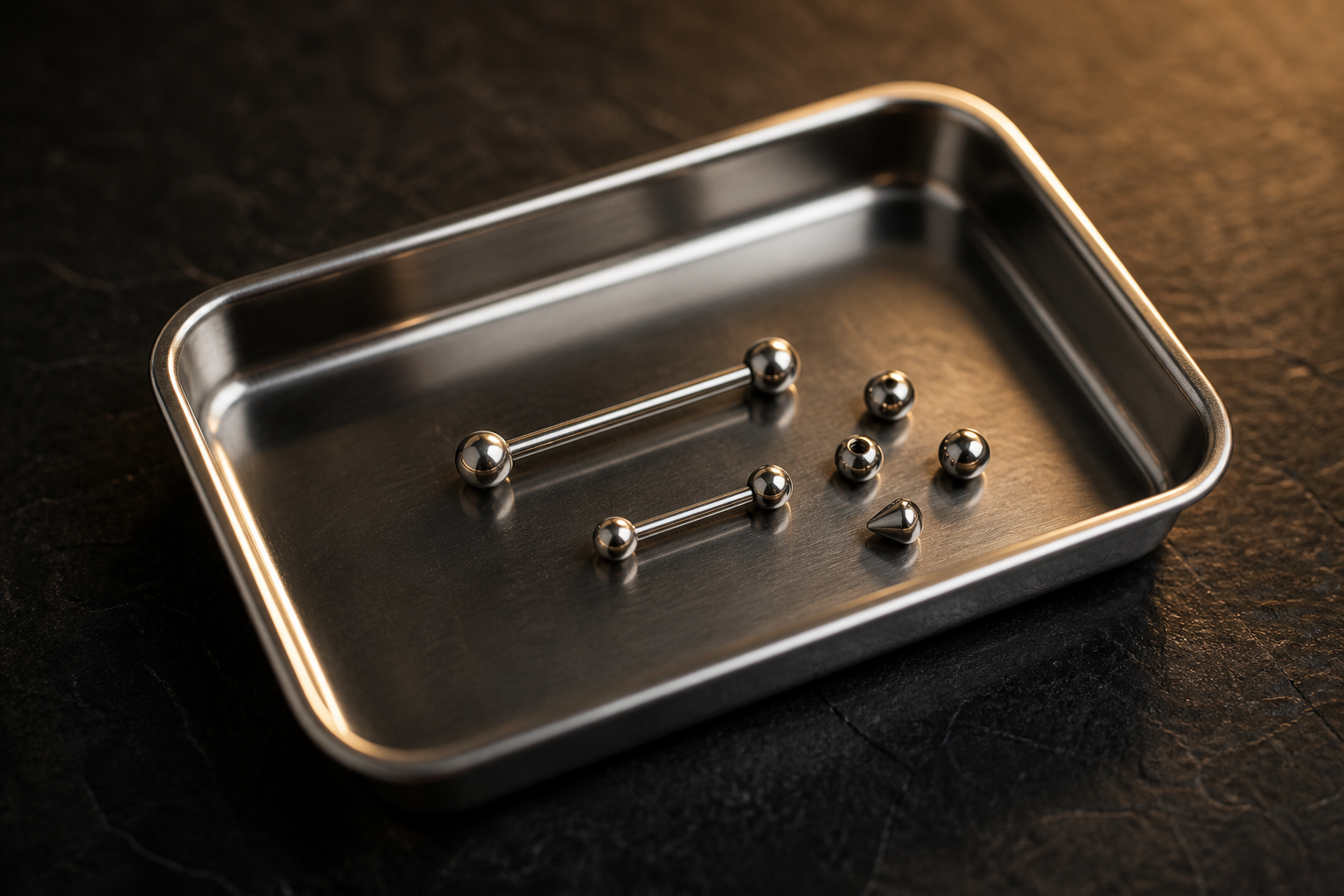
Downsizing means replacing the initial longer jewelry with a shorter properly fitted piece after early swelling has subsided.
APP specifically recommends professional downsizing for many piercings.
The purpose is not cosmetic alone.
Shorter appropriate jewelry reduces excessive movement, snagging, leverage, and irritation.
In some placements, correct fit also helps protect surrounding structures.
For oral piercings, appropriate downsizing helps reduce unnecessary contact with teeth and gums.
Downsizing Does Not Mean Fully Healed
This is the part many clients misunderstand.
A piercing may need shorter jewelry while the inside of the channel is still fragile.
That means the piercing can be ready for a professional fit correction without being ready for you to repeatedly remove and reinstall jewelry at home.
The downsize is part of healing.
It is not proof that healing is finished.
When Should a Piercing Be Downsized?
There is no universal calendar date for every placement.
The right timing depends on the piercing, initial swelling, anatomy, jewelry, and how the tissue is behaving.
The useful signal is that the original swelling has reduced enough for the initial jewelry to become unnecessarily long.
Your piercer should tell you whether the placement commonly needs a downsize and when they want to see it again.
If the post is moving excessively, catching constantly, or visibly much longer than it was during swelling, schedule a fit check.
Why Leaving Jewelry Too Long Can Cause Problems
Extra length creates motion.
Motion creates friction.
Friction can keep a healing channel irritated.
Long posts can also snag hair, clothing, towels, headphones, and bedding.
In ear cartilage, that leverage can contribute to angle problems and persistent irritation.
For oral jewelry, excess length can increase contact with teeth and gums.
The initial room served a purpose.
Once that purpose is gone, the fit should be reassessed.
Why Changing Jewelry Too Early Can Cause Problems
A piercing can look calm before the inside is stable.
Removing the jewelry can traumatize delicate tissue.
Reinsertion can be difficult.
The channel may tighten rapidly.
The new jewelry may be the wrong gauge, material, length, or style.
A decorative change that takes five minutes can create weeks of renewed irritation.
The calendar should not be the only thing deciding readiness.
Piercing Healing Times“But It Doesn’t Hurt Anymore”
Pain is not a healing test.
A piercing can stop hurting early.
That simply means the acute inflammatory phase has settled.
The internal channel still needs time to mature.
This is the same reason someone can bump a cartilage piercing that felt completely normal and suddenly have several irritated days.
Comfort is good.
It is not proof of complete tissue stability.
Jewelry Style Changes the Mechanics
Changing from a stud-style piece to a ring is not always a neutral swap.
A ring moves differently.
Its curve changes the way pressure is applied.
Diameter affects leverage and movement.
The fact that a ring physically fits through the hole does not automatically mean the piercing is ready to heal comfortably with it.
Ask whether the desired style is appropriate for the placement and stage of healing.
Material Still Matters After the First Change
Do not downgrade material quality just because the piercing looks healed.
If your body has been doing well with high-quality jewelry, switching to poorly finished or mystery-metal jewelry can introduce a new source of irritation.
Decorative jewelry should still be appropriately manufactured, sized, and compatible with your body.
Piercing Jewelry GuideDo Not Leave Jewelry Out Just to “Let It Breathe”
Piercings can shrink or close surprisingly quickly.
APP specifically warns that even well-healed piercings may tighten or close rapidly when jewelry is removed.
That varies from person to person.
A newer piercing can be especially unforgiving.
If you want to keep the piercing, do not assume you can leave the jewelry out for hours or days and easily put it back later.
Medical and Dental Procedures
Sometimes jewelry needs to be removed temporarily for a medical or dental procedure.
Do not wait until the last minute if the piercing matters to you.
Ask the healthcare facility what is actually required and contact a piercer about appropriate temporary alternatives where possible.
APP provides separate guidance on preparing for medical and dental procedures because jewelry removal and reinsertion can be more complicated than people expect.
If the Jewelry Will Not Go Back In, Do Not Force It
Forcing jewelry through a tightened channel can tear tissue or create a false path.
If the piece does not slide through normally, stop.
A professional piercer may be able to assess whether the channel is still open and use appropriate insertion tools.
The fact that you cannot insert jewelry yourself does not always mean the piercing is completely gone.
But forcing it is not the way to find out.
Treat the First Jewelry Change as Part of the Piercing
The best time to plan your first change is when you get pierced.
Ask whether the placement typically needs a downsize.
Ask what final jewelry styles may work later.
Ask what signs indicate the piercing is ready.
Then follow up.
Piercing is easier when jewelry management is treated as part of the process instead of an afterthought.