Piercing Names Are Only the Starting Point
A piercing name tells you the general area.
It does not tell you exactly where the jewelry should sit on your body.
Human anatomy varies. Ear ridges are shaped differently. Navels have different depth and movement. Brows, noses, lips, and cartilage structures are not interchangeable from one person to the next.
That is why a professional anatomy check matters.
You may arrive asking for a specific piercing and discover that a slight placement adjustment will work better. In some cases, another style creates a similar look with a better anatomical fit.
The best result is not the piercing that matches a reference photo millimeter for millimeter. It is the one correctly placed on your anatomy.
The Complete Guide to Getting a Piercing at Against the GrainEarlobe Piercings
Lobes are among the most familiar placements and can support everything from a single classic piercing to curated multi-lobe arrangements.
Because the tissue is softer and more vascular than cartilage, lobe piercings often have shorter average healing periods than upper-ear cartilage.
That does not mean they are maintenance-free.
Initial jewelry still needs appropriate material and fit. Sleeping directly on a new piercing, touching it repeatedly, or changing jewelry too early can still create irritation.
For multiple lobes, spacing matters. A professional layout should consider the jewelry you eventually want to wear rather than placing every hole without thinking about the full composition.
Helix and Upper-Ear Cartilage
Helix piercings sit in cartilage along the outer upper ear.
They are visually versatile but usually require more patience than lobes.
Cartilage has less blood supply than soft earlobe tissue, and APP educational material places many ear-cartilage piercings in a healing range of roughly six to nine months or longer.
Pressure matters here.
Sleeping on the piercing, tight headphones, helmets, hair snagging, and phone pressure can all keep cartilage irritated long after the initial tenderness disappears.
A helix that looks calm at two months may still be healing internally.
Tragus
The tragus is the small cartilage projection in front of the ear canal.
It can create a subtle focal point, but the placement intersects with everyday objects more than people sometimes realize.
Earbuds, in-ear hearing devices, stethoscopes, and anything else entering the ear can become practical considerations while the piercing heals.
The anatomy of the tragus also varies. Thickness, shape, and available tissue affect placement and jewelry.
If earbuds are a non-negotiable part of your daily life, discuss that before committing to the piercing.
Conch
Conch piercings sit in the central cartilage area of the ear.
They can create a strong visual anchor in a curated ear.
Healing still follows cartilage rules rather than earlobe rules.
That means months rather than a quick few weeks, plus attention to sleeping pressure and anything that presses against the side of the ear.
Rook and Daith
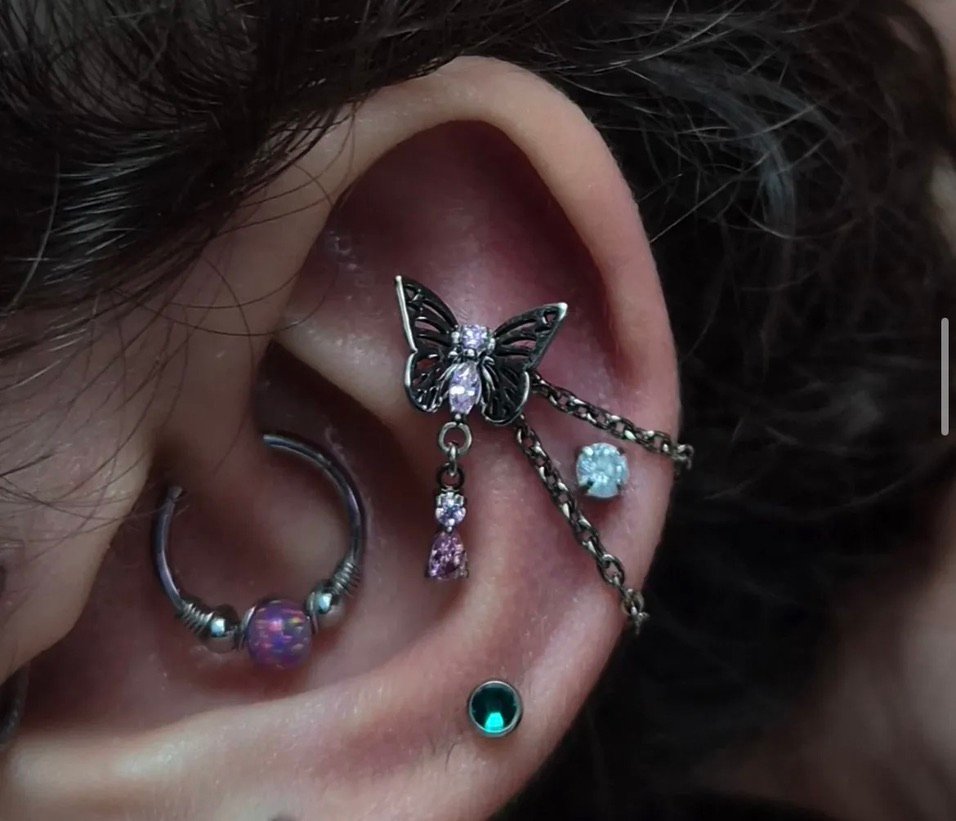
Rook and daith piercings sit within distinct cartilage folds.
These are highly anatomy-dependent placements.
Not every ear has the same ridge depth, angle, or amount of tissue needed for the piercing to sit correctly.
They also live in areas where cleaning should remain gentle rather than aggressive. Trying to force tools or fingers into every angle can create more irritation than it solves.
Both are cartilage projects. APP materials describe rook and daith healing in the same broad six-to-nine-month-or-longer category as other ear cartilage.
Nostril Piercings
Nostril piercings are highly visible while remaining visually simple.
The placement can be adjusted based on anatomy, desired jewelry style, facial balance, and whether future paired piercings are being considered.
Initial jewelry selection matters because the piece must accommodate swelling without creating unnecessary movement.
Nostril piercings can also be exposed to makeup, skin-care products, towels, glasses, and frequent unconscious touching.
APP educational material lists nostril healing around three to four months or longer as a broad average, but individual healing can extend beyond that.
Septum Piercings
A correctly placed septum piercing is anatomy-driven.
Professional piercers generally look for suitable tissue rather than simply piercing through the thickest part of the nasal septum.
Jewelry style and diameter affect the way the piercing sits and whether it can be comfortably worn in the intended position.
APP educational material lists septum healing around six to eight weeks or longer as a broad average minimum.
As with every piercing, the actual healing timeline belongs to the person, not the calendar.
Eyebrow Piercings
Eyebrow piercings are surface-oriented and depend on suitable tissue and placement.
They can also be exposed to towels, makeup, hair, sleeping pressure, helmets, hats, and accidental snagging.
Surface-oriented piercings deserve attention to migration.
If the jewelry appears to be moving closer to the surface over time or the bridge of tissue between the openings becomes progressively thinner, a qualified piercer should evaluate it.
Persistent migration is not something to solve by adding more aftercare product.
Lip and Labret Piercings
Lip piercings involve both external tissue and the inside of the mouth.
That changes the aftercare and jewelry conversation.
Initial posts may need additional length for swelling and then a professional downsize after swelling resolves. Jewelry that remains too long can contact teeth and gums more than necessary.
APP guidance also notes that some healed lip jewelry can nest slightly into the inner lip, which is different from jewelry becoming dangerously embedded.
Oral piercings should be monitored with both tissue healing and dental health in mind.
Lip and labret piercings are among the placements discussed on Against the Grain’s piercing services page.
Piercing Jewelry GuideTongue Piercings
Tongue piercings can swell substantially during the early phase.
That is why properly sized initial jewelry and follow-up downsizing matter.
APP oral guidance recommends maintaining good oral hygiene, avoiding unnecessary movement and playing with the jewelry, and replacing the longer initial bar with a shorter appropriate piece after swelling resolves.
Long-term contact with teeth and gums is a meaningful consideration.
Tongue piercings are among the placements discussed on Against the Grain’s piercing services page. The details above are general education, not a shop-specific procedure description.
Navel Piercings
Navel piercings are strongly anatomy- and lifestyle-dependent.
The shape of the navel, how it changes when sitting or bending, and the amount of suitable tissue all matter.
Waistbands are another major factor.
If clothing repeatedly presses directly across the jewelry, the piercing can be subjected to hours of friction every day.
APP material places navel healing broadly around six to nine months or longer, which is why a navel piercing that seems comfortable early is still a long-term healing commitment.
Nipple Piercings
Nipple piercings require appropriate anatomy, jewelry sizing, and privacy-sensitive professional technique.
They can be irritated by tight clothing, snagging, sports, and repeated compression.
Healing can take months, and the area should not be treated as finished simply because early soreness has resolved.
Age rules and service lists are shop-specific, so this section is general education rather than a claim that Against the Grain offers every placement discussed here.
Curated Ear Projects
A curated ear is not simply more piercings.
The stronger approach considers negative space, jewelry scale, anatomy, symmetry or intentional asymmetry, and room for future placements.
The sequence can matter too.
Trying to heal several piercings on both ears simultaneously can make sleeping and aftercare more complicated. A professional can help decide which placements make sense to group and which are better staged over time.
The result should look planned even if the collection grows gradually.
The Right Placement Is the One Your Body Can Support
Reference photos are useful.
They show what you like.
But anatomy decides what can be executed well.
Go into the consultation with a preferred direction rather than demanding an exact copy of somebody else’s anatomy.
A small adjustment in angle, jewelry, or placement can be the difference between a piercing that constantly fights your body and one that looks like it was always meant to be there.
Piercings at Against the Grain