
This article provides general piercing aftercare education and is not medical diagnosis or treatment. Follow the specific instructions given by your qualified piercer. Seek qualified medical care when infection or another medical complication is suspected.
The Goal Is to Support Healing, Not Constantly Sterilize the Skin
Your body is doing the healing.
Aftercare is there to reduce contamination and unnecessary irritation while that happens.
More cleaning is not automatically better.
Scrubbing, rotating, soaking in strong homemade solutions, and repeatedly applying harsh chemicals can keep tissue inflamed.
APP aftercare guidance favors a simpler approach.
Wash your hands before touching the piercing, use appropriate sterile saline, gently remove softened debris when needed, dry with clean disposable material, and otherwise leave the jewelry alone.
The Complete Guide to Getting a Piercing at Against the GrainUse Sterile Saline Wound Wash
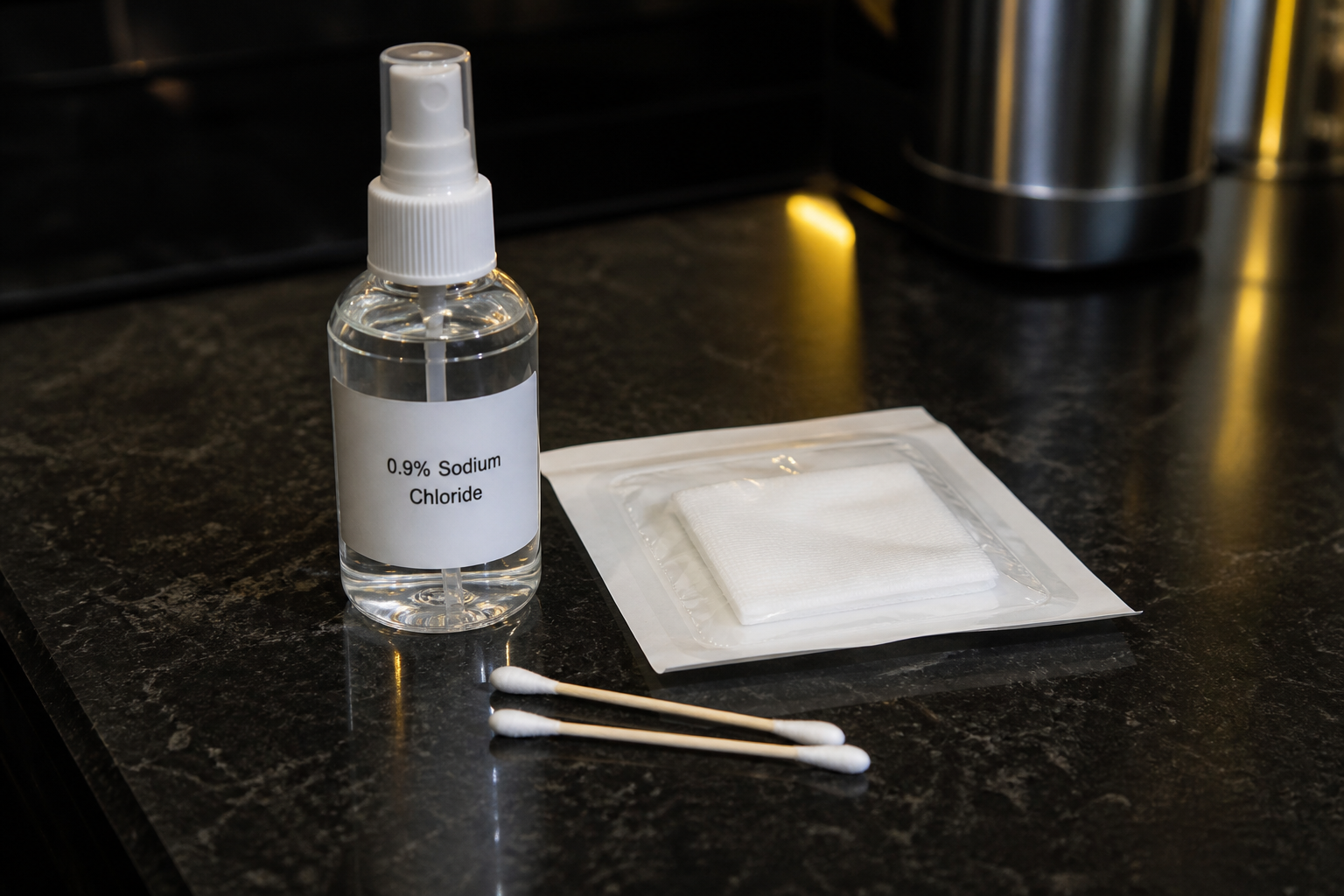
APP currently recommends packaged sterile saline labeled for wound wash.
The ingredient list should be simple: 0.9% sodium chloride, sometimes with purified water listed.
Avoid saline products with moisturizers, antibacterials, medications, or unnecessary additives.
Contact-lens solution, nasal sprays, and eye drops are not automatically equivalent products simply because they contain the word saline.
The concentration and intended use matter.
Skip the Homemade Salt Chemistry Experiment
Older piercing advice often included mixing sea salt at home.
APP no longer recommends homemade sea-salt solution as the preferred approach because people commonly make it too strong.
A hyper-concentrated salt solution can dry and irritate healing tissue.
Stronger is not cleaner.
If sterile wound-wash saline is available, it removes the guesswork.
Wash Your Hands Before Touching It
Many aftercare problems begin with unnecessary touching.
Hands contact phones, keyboards, handles, surfaces, pets, food, and everything else in daily life.
Do not absentmindedly twist, check, squeeze, or play with the piercing.
When you do need to clean or inspect it, wash your hands first.
The easiest contamination to prevent is the contamination you were about to introduce yourself.
Do Not Rotate or Spin the Jewelry
A healing piercing does not need jewelry rotated through it.
APP guidance specifically says moving or rotating jewelry is unnecessary during cleaning and can irritate the piercing.
The tissue is healing around the jewelry.
Repeatedly turning it can drag crust or debris through the channel and mechanically disturb new tissue.
Clean around the piercing gently.
Leave the jewelry in place.
Clean the piercing. Do not exercise it.
Against the Grain
Dry It Without Creating More Trauma
After rinsing or cleaning, dry gently.
APP suggests clean disposable materials such as gauze or cotton swabs used carefully.
Cloth towels can snag jewelry and may carry bacteria.
The goal is not to scrape every microscopic crust away.
If debris is softened and comes away easily, remove it gently.
If you have to dig, pick, or force it, stop.
Avoid Harsh Routine Products
APP advises against routine aftercare with alcohol, hydrogen peroxide, iodine, harsh antibacterial soaps, and similar irritating products.
These can damage or dry tissue and delay healing.
Routine ointment use is also not standard piercing aftercare because heavy occlusive products can interfere with the environment a healing piercing needs.
Do not put random skin-care products, cosmetics, lotions, oils, or sprays directly around a fresh piercing simply because they are safe on intact skin.
A piercing channel is not intact skin yet.
Do Not Over-Clean
People often respond to irritation by cleaning more aggressively.
That can create a feedback loop.
The skin becomes dry and inflamed.
The piercing looks worse.
The person cleans even more.
APP warns that over-cleaning can delay healing and irritate tissue.
If the piercing looks persistently unhappy, assess pressure, jewelry fit, products, and trauma rather than assuming the answer is another cleaning session.
Showers vs. Soaking
Normal showering can help rinse a piercing.
Submerging a healing piercing in pools, lakes, oceans, hot tubs, and baths creates a different exposure.
APP advises avoiding submersion during healing or using appropriate protection in circumstances where it cannot be avoided.
The problem is not simply getting it wet.
The problem is prolonged soaking and exposure to microorganisms or chemicals in shared or natural water.
Sleeping Is Aftercare
You spend hours asleep.
That means sleep position can create more sustained pressure than almost anything you do while awake.
For healing ear piercings, sleeping directly on the jewelry can cause irritation and change the angle of pressure.
A travel pillow or another setup that keeps pressure off the ear can help some people.
Clean bedding matters too.
If the piercing is repeatedly angry on the same side you sleep on, that is useful information.
Hair, Clothing, Headphones, and Daily Friction
Aftercare is not only what you spray on the piercing.
It is also what repeatedly touches it.
Hair can wrap around jewelry.
Shirts can catch earrings.
Waistbands can pressure navels.
Headphones and helmets can press on cartilage.
Makeup and hair products can collect around facial and ear piercings.
Look at your routine and reduce repeated contact where possible.
Exercise Is Not Automatically Forbidden
APP guidance says exercise and sweating during healing can be fine.
The bigger issue is aggravation and contamination.
Protect the piercing from equipment and surfaces, avoid movements that repeatedly jostle or rub the area, and clean up normally afterward.
A piercing near a waistband, joint, or equipment contact point may need more modification than one in a protected area.
Use common sense about the placement.
Oral Piercing Aftercare Is Different
Inside the mouth, APP oral guidance emphasizes normal oral hygiene, plain clean water, and appropriate alcohol-free/hydrogen-peroxide-free mouth rinse.
Sterile saline is useful for the external side of lip piercings, not as something to routinely swallow.
Playing with oral jewelry should be avoided because repeated contact can damage teeth and gums.
Once early swelling subsides, appropriate downsizing is especially important.
Tongue and lip piercings are among the placements discussed on Against the Grain’s piercing services page. This section is general oral-aftercare education rather than a promotional procedure description.
Do Not Remove Jewelry Just Because the Piercing Is Angry
If a piercing is irritated, removing the jewelry can allow the channel to shrink or close rapidly.
If infection is suspected, casual removal can be especially problematic because closing the openings may trap infection.
APP advises discussing jewelry removal with a physician in suspected infection cases.
If the problem is jewelry fit or material, a qualified piercer may be able to change the jewelry safely.
Do not turn removal into the default response to every problem.
Know When Aftercare Stops Being the Main Question
Aftercare cannot fix every problem.
If jewelry is embedding, the fit may be wrong.
If the piercing is migrating, the anatomy or placement may be failing.
If the jewelry is constantly snagging because the post is too long, it may need a downsize.
If the area is increasingly hot, painful, swollen, spreading in redness or discoloration, producing significant pus, or accompanied by fever or feeling ill, the issue may require medical evaluation.
Piercing Bumps, Irritation & InfectionBoring Aftercare Wins
Wash your hands.
Use appropriate sterile saline.
Rinse gently.
Dry carefully.
Do not rotate the jewelry.
Do not drown the piercing in harsh chemicals.
Avoid unnecessary pressure, friction, and soaking.
Return for professional follow-up when jewelry fit changes.
If something looks medically wrong, get medical care.
That routine is less exciting than a ten-product aftercare kit.
It is also much more sensible.