Initial Jewelry Has a Different Job
Jewelry for a healed piercing can be chosen mostly around comfort, compatibility, and style.
Initial jewelry has to function inside fresh tissue.
That makes the standard higher.
The piece needs to tolerate sterilization, have an appropriate material composition, be smooth enough not to traumatize the channel, fit the anatomy, and allow for expected swelling.
A beautiful piece that is the wrong size, material, or design is still the wrong initial jewelry.
The Complete Guide to Getting a Piercing at Against the Grain“Surgical” Is Not a Complete Material Specification
Marketing names can be misleading.
“Surgical steel” describes a broad family of alloys, not one universal body-safe material.
APP guidance focuses on documented material standards.
For steel, examples include specific implant-compliant grades such as ASTM F138 or ISO 5832-1 compliant steel.
For titanium, APP identifies implant-certified titanium such as ASTM F136-compliant Ti6Al4V ELI and commercially pure titanium meeting ASTM F67 as suitable examples.
The point is not that every client needs to memorize metallurgy.
The point is that a professional studio should know what its jewelry is made from and source documented quality.
Implant-Grade Titanium
Implant-grade titanium is widely used in professional piercing because it is lightweight, corrosion-resistant, and available in documented biocompatible grades.
It is also useful for people concerned about nickel sensitivity.
Titanium can be anodized into different colors without adding a painted coating. The color comes from changing the oxide layer on the metal.
That means color does not automatically require sacrificing a high-quality base material.
Not every piece marketed as titanium is automatically implant grade, which is why the standard or manufacturer documentation matters.
Steel
Certain documented steels can be appropriate for fresh piercings.
The problem is treating every stainless or surgical steel product as identical.
Steel alloys can contain nickel, and composition matters.
APP jewelry guidance identifies specific compliant steel standards rather than endorsing steel as one undifferentiated category.
For someone with known metal sensitivity, titanium is often an especially useful material to discuss with the piercer.
Solid Gold
Gold can be appropriate for initial piercings when the alloy and construction are suitable.
APP guidance supports appropriate solid gold of at least 14k, with biocompatible alloying and without problematic nickel or cadmium.
Extremely soft high-karat gold can scratch or deform more easily, which is why professional body jewelry commonly stays within a practical range rather than assuming higher karat is always better.
Gold-plated, gold-filled, overlay, and vermeil pieces are not equivalent to solid appropriate gold for a fresh piercing.
The surface coating can wear, chip, or expose the base metal underneath.
Niobium, Platinum, and Glass
Professional piercing jewelry is not limited to titanium and gold.
APP guidance also discusses niobium, platinum, and specific inert glasses as appropriate materials in suitable applications.
The correct choice depends on the placement, jewelry design, availability, and professional judgment.
This is another reason jewelry selection is more technical than choosing whatever metal color looks best in a display case.
Surface Finish Matters
Fresh tissue is delicate.
Jewelry surfaces should be smooth and free of nicks, scratches, burrs, and manufacturing residue.
A rough surface can repeatedly damage newly forming tissue as the jewelry moves.
That can prolong healing and create a cycle of irritation.
High-quality metal body jewelry is polished to a smooth finish because microscopic surface quality affects more than appearance.
Internally Threaded vs. Externally Threaded
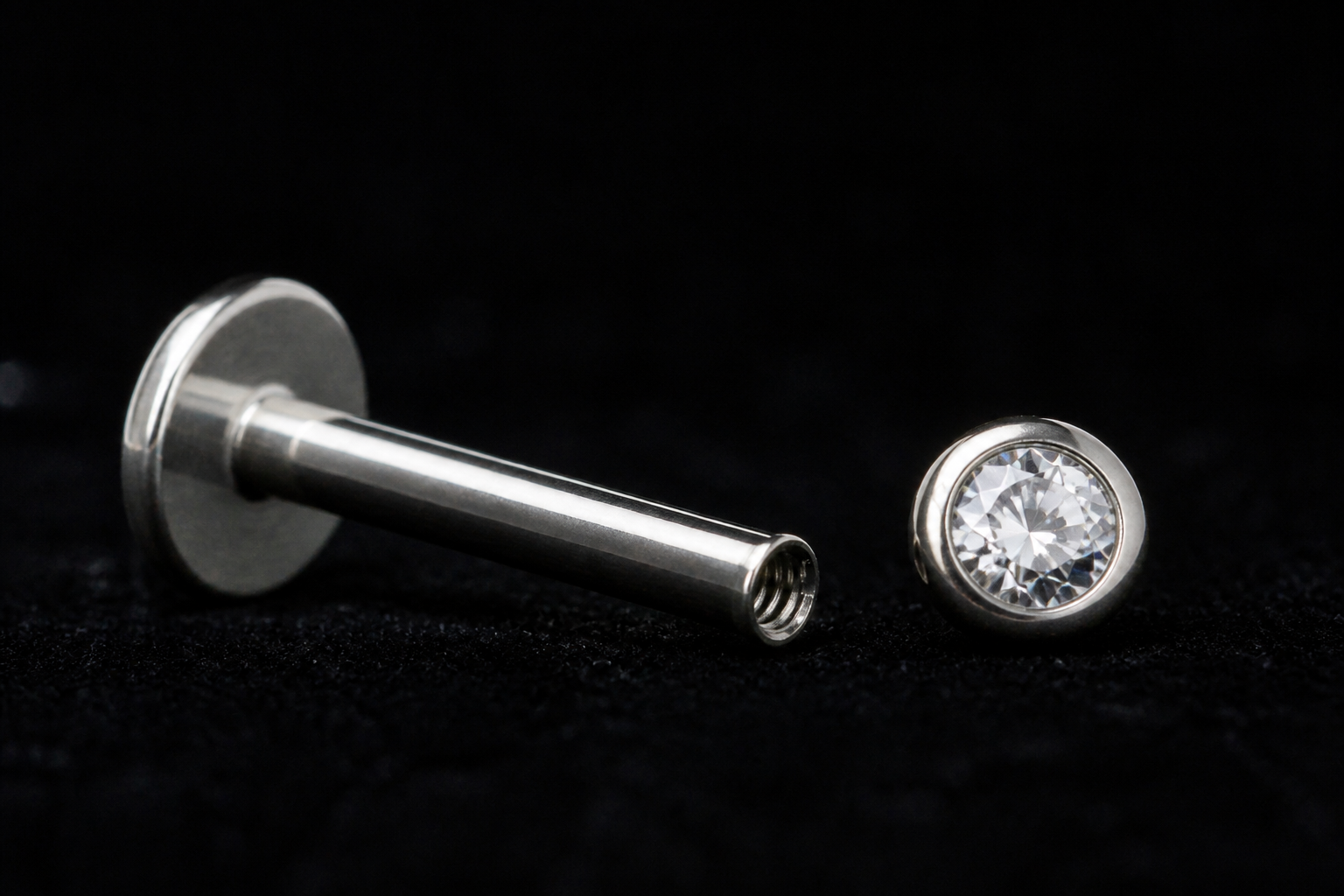
Threaded jewelry uses screw threads to attach decorative ends.
With externally threaded jewelry, the rough threads are on the shaft that may pass through the piercing channel.
With internally threaded jewelry, the shaft that passes through tissue is smooth and the threads are contained inside the jewelry.
APP initial-jewelry standards favor internally threaded jewelry for this reason.
Threadless press-fit systems are another accepted professional option because the post itself has no screw threads passing through tissue.
Gauge Is Not Just a Number
Gauge describes jewelry thickness.
The appropriate gauge depends on placement, anatomy, and jewelry style.
Jewelry that is too thin for a placement can concentrate pressure into a smaller area and may contribute to migration or instability.
Larger is not automatically better either.
The piercer selects a gauge that makes sense for the tissue and intended jewelry.
Do not change gauge casually during healing without professional guidance.
Length and Diameter
Jewelry fit is three-dimensional.
A straight post has length. A ring has diameter. Curved jewelry has dimensions that affect how it sits.
Fresh piercings often need room for swelling.
Too little room can mean pressure or embedding.
Too much room after swelling resolves can mean extra leverage, snagging, movement, and irritation.
That is why the correct length can change during healing.
Downsizing Is Part of Jewelry Fit
Downsizing means moving from the longer initial jewelry to a shorter appropriately fitted piece after early swelling subsides.
APP emphasizes downsizing because excessively long jewelry can move and snag.
For oral piercings, leaving jewelry too long can also increase contact with teeth and gums.
A downsize does not mean the piercing is fully healed.
In fact, it often happens while the inside is still fragile, which is why a qualified piercer should normally perform it.
Changing & Downsizing Piercing JewelryJewelry Style Must Match the Placement
Not every placement should start with the same jewelry shape.
Some piercings are best suited to straight posts, some curved bars, some rings, and some placement-specific designs.
The decision is based on anatomy, healing mechanics, and how pressure is distributed.
Choosing a ring simply because you prefer the look may not always be the best initial configuration for a particular piercing.
Ask what the piercer recommends for healing first.
You can plan future styling after the piercing is stable enough for it.
Cheap Jewelry Can Be Expensive to Fix
Low-cost jewelry is not automatically bad, and expensive jewelry is not automatically perfect.
But body jewelry quality has real manufacturing costs.
Documented material, precise machining, smooth polishing, secure settings, quality threading, and professional sterilization all require more than stamping out a decorative accessory.
If jewelry causes persistent irritation, embeds because it is incorrectly sized, loses poorly secured ends, or exposes low-quality base metal, replacing the piece becomes part of solving the problem.
Buy for healing first.
Style can still be excellent without compromising the fundamentals.
Ask Better Jewelry Questions
You do not need to ask for a chemistry lesson.
Useful questions include what material the jewelry is, whether that material is documented to an appropriate ASTM or ISO standard, whether the piece is internally threaded or threadless, why the length or diameter suits your anatomy, whether the piercing will likely need a downsize, and what styles may work after healing.
A professional should be comfortable explaining the basics.