
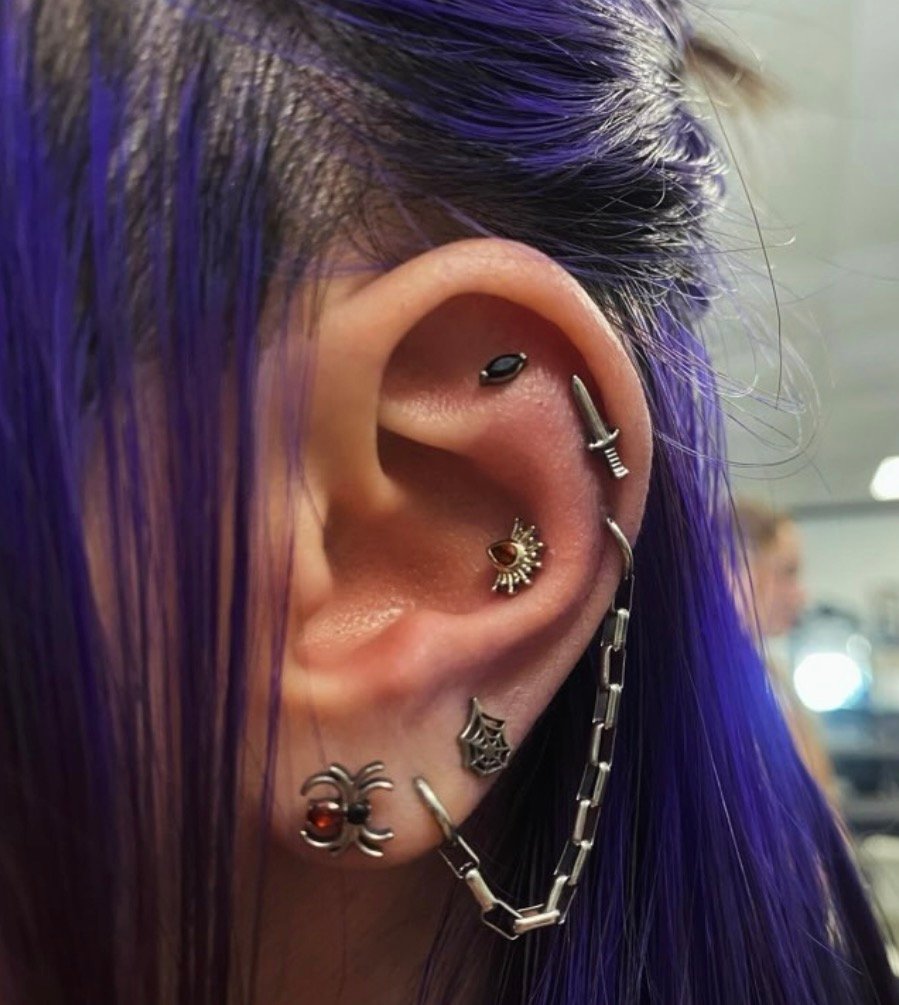
“Feels Fine” Is Not the Same as Healed
Piercings can be deceptive.
The swelling drops.
The redness fades.
You stop noticing the jewelry.
Then it is easy to assume the piercing is finished.
But the channel heals from the outside inward. APP guidance specifically warns that a piercing can appear healed while the tissue inside remains fragile.
That is why changing jewelry too early or repeatedly removing it can create problems even after the piercing seems calm.
The Complete Guide to Getting a Piercing at Against the GrainHealing Times Are Ranges, Not Deadlines
There is no day on the calendar when every piercing of a certain type becomes healed.
APP educational material provides average minimum ranges and repeatedly adds “or longer.”
That language matters.
Healing is affected by anatomy, blood supply, pressure, jewelry fit, health, aftercare, accidental trauma, smoking, stress, sleep, and the way the piercing is used in daily life.
Treat the average as planning information, not a guarantee.
Earlobes
APP educational material lists earlobe healing around six to eight weeks or longer as a broad average.
Lobes often settle more quickly than cartilage because they contain soft tissue with relatively strong blood flow.
That does not make six weeks an automatic jewelry-change date.
If the piercing is still tender, crusting heavily, swollen, irritated, or unstable, it needs more time and possibly professional evaluation.
Ear Cartilage
Cartilage is a longer project.
APP material lists many ear-cartilage placements—including conch, daith, rook, tragus, and other cartilage variations—around six to nine months or longer.
That surprises people because a cartilage piercing may look normal far earlier.
The problem is that pressure and repeated trauma can keep reactivating irritation.
Sleeping on the piercing every night can matter more than the number of weeks that have passed.
Nostril
APP educational material places nostril healing around three to four months or longer.
During that time, irritation bumps can appear when the piercing is repeatedly snagged, moved, pressured, or fitted with inappropriate jewelry.
A bump does not automatically mean infection.
The first step is often identifying the mechanical or aftercare source of irritation.
Piercing Bumps, Irritation & InfectionSeptum
APP material lists septum healing around six to eight weeks or longer as a broad average minimum.
Correct placement and appropriate jewelry matter substantially.
Even when the piercing feels comfortable, unnecessary early jewelry changes can traumatize tissue that is still stabilizing internally.
A professional can tell you whether the piercing is actually ready for a style change.
Lip Piercings
APP material places lip piercings around two to three months or longer.
Swelling is an important early consideration.
Initial jewelry may need extra length and then a professional downsize as swelling resolves.
A lip piercing can therefore need a jewelry change for fit before it is fully healed enough for casual decorative changes.
That distinction is important.
Tongue
APP material lists tongue healing around six to eight weeks or longer.
Tongues can swell significantly during the early phase, so appropriately sized initial jewelry and timely downsizing are particularly important.
The mouth can feel dramatically better after the first week while the piercing is still healing.
Do not confuse reduced swelling with complete tissue stability.
Navel
APP material places navel healing around six to nine months or longer.
Navels also deal with movement and clothing friction.
Sitting, bending, waistbands, athletic clothing, and sleeping positions can repeatedly pressure the area.
That makes jewelry fit and lifestyle management as important as cleaning.
Why Healing Slows Down
Persistent healing problems often have a cause.
Common contributors include sleeping on the piercing, snagging, jewelry that is too long or too tight, unsuitable jewelry material or design, harsh cleaning products, over-cleaning, changing jewelry prematurely, friction from clothing or equipment, repeated touching, and submerging the piercing during healing.
The solution is not always “clean it more.”
Sometimes the piercing needs less trauma and a better fit.
Normal Healing Can Look Uneventful or Weird
During normal healing, APP guidance notes that some swelling, tenderness, discoloration, itching, and a small amount of pale secretion that dries into crust can occur.
The tissue may tighten around the jewelry as it stabilizes.
What matters is pattern and severity.
Normal healing should generally move toward greater stability over time even if it has occasional irritated days.
Symptoms that become progressively hotter, more painful, more swollen, spread beyond the piercing, produce significant pus, or make you feel systemically unwell deserve medical attention.
Healing Is Not Perfectly Linear
A piercing can have a good week and then become irritated after one night of sleeping on it.
That does not necessarily mean the entire healing process has restarted.
Healing tissue can react to trauma.
The useful question is what changed.
Did the jewelry get snagged? Did you start using headphones again? Did you change jewelry? Did a post become excessively long after swelling dropped? Did you introduce a new skin-care product?
Finding the cause is more useful than panicking about the appearance.
Downsizing Can Happen Before Full Healing
This is one of the most confusing parts of the timeline.
A piercer may recommend changing the initial jewelry to a shorter post while simultaneously telling you the piercing is not fully healed.
Both can be true.
A downsize is a fit correction.
The original post was intentionally long enough for swelling. Once that swelling disappears, the extra length can become a source of movement and irritation.
Because the channel is still healing, that change is normally best handled professionally.
Changing & Downsizing Piercing JewelryLet the Piercing Earn the Next Step
Do not change jewelry because a minimum number of weeks passed.
Do not sleep on it because it stopped hurting.
Do not stop caring for it because the outside looks normal.
Use the timeline as a guide and the condition of the actual piercing as the decision point.
When the next step matters, have the piercing assessed.
Patience is not passive.
It is part of the procedure.